Most of what looks like extraordinary talent is ordinary human capacity that received an extraordinary concentration of the right inputs: directed attention, honest feedback, real reps, and enough time. The Human Capability System is the operating model that organizes those inputs. It connects three frameworks that are usually taught in separate rooms, and it names what happens when you run them together over years.
Direct it. Test it. Update it. Transfer it. Compound it.
What this is, and what it is not
This is a synthesis, not a new science. Every layer rests on established work: active inference, learning science, and the transfer literature. The contribution here is the integration and the translation to how a working professional actually builds skill, not the discovery of new mechanisms. Where a claim is my own proposal rather than settled fact, it is labeled that way, on this page and on the pages it links to.
Read it as a practitioner's operating model with a citable spine, not as a proof.
1. The A2 System: Direct the Mind
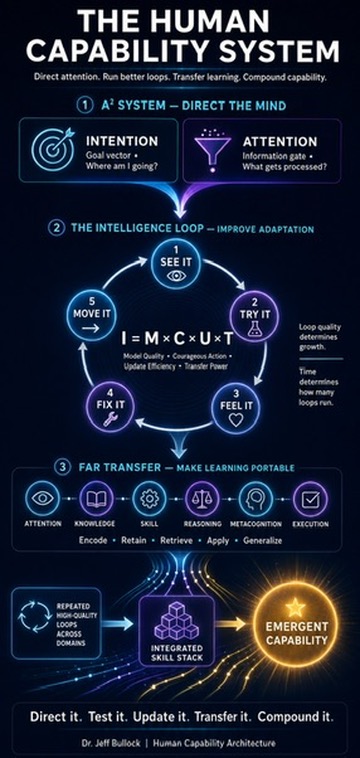
Two forces set the direction of any learning: intention (the goal vector, "where am I going?") and attention (the information gate, "what actually gets processed?"). The A2 System maps these onto the two established terms of the Expected Free Energy equation in Karl Friston's active inference. The decomposition is real math. The reading of it as intention and attention is a proposed interpretation, spelled out in the framework paper.
If either force is near zero, the output collapses. High intention with no attention stalls. High attention with no intention is efficient irrelevance.
Read the A2 System framework and the theoretical foundation.
2. The Intelligence Loop: Improve Adaptation
Direction is not enough. Improvement comes from a cycle run at quality and volume: See it, Try it, Feel it, Fix it, Move it. Attempt, feedback, adjustment, better attempt. Effort without that loop produces exhaustion. Effort inside it produces skill.
The working shorthand is:
I = M x C x U x T
Intelligence as a function of Model Quality, Courageous Action, Update Efficiency, and Transfer Power. Loop quality determines how much you grow per cycle. Time determines how many cycles you run. This is a diagnostic model for where a learning cycle is leaking, not a measured law.
3. Far Transfer: Make Learning Portable
A skill that only works in the room it was learned in is a narrow skill. Far Transfer is the layer that moves capability across contexts, through six domains: attention, knowledge, skill, reasoning, metacognition, and execution. Encode, retain, retrieve, apply, generalize.
Transfer is hard and the research is honest about that. Documented far transfer is rarer than most training programs assume, which is exactly why it has to be trained deliberately rather than hoped for.
4. Compounded Capability
Run high-quality loops across enough domains and the skills stop sitting in separate boxes. They start to combine. A pattern from one field reorganizes how you see another. The result is an integrated skill stack that can do things no single skill on the stack was trained to do.
The infographic calls this "emergent capability." The more precise word is compounded capability. In AI research the term "emergent" carries a live dispute about whether apparent emergence is real or an artifact of how you measure it, so this page uses "compounded" to describe what is really happening: combinatorial gains from strategically stacked, well-transferred skills.
Where the ideas come from
Naming the lineage is part of the integrity of the model.
- Direction and information selection: Friston's Free Energy Principle and active inference (the Risk and Ambiguity terms are established; the intention and attention mapping is my proposal).
- The improvement loop: experiential learning and Bayesian, predictive-processing accounts of how belief updates on feedback.
- Portability: the far-transfer literature, including the honest finding that far transfer is difficult.
- Compounding: knowledge recombination in innovation research, going back to Schumpeter, and Stuart Kauffman's "adjacent possible." Breadth of exposure widens the set of pieces available to recombine.
Status
Working synthesis (Bullock, 2026). Evidence status: the component science is established and cited on the linked pages; the integration into a single operating model, and the specific mappings noted above, are proposed and open to test. This page will be updated as the underlying claims are validated or revised.
Author: Dr. Jeff Bullock, PharmD | ORCID: 0009-0009-2053-4854