
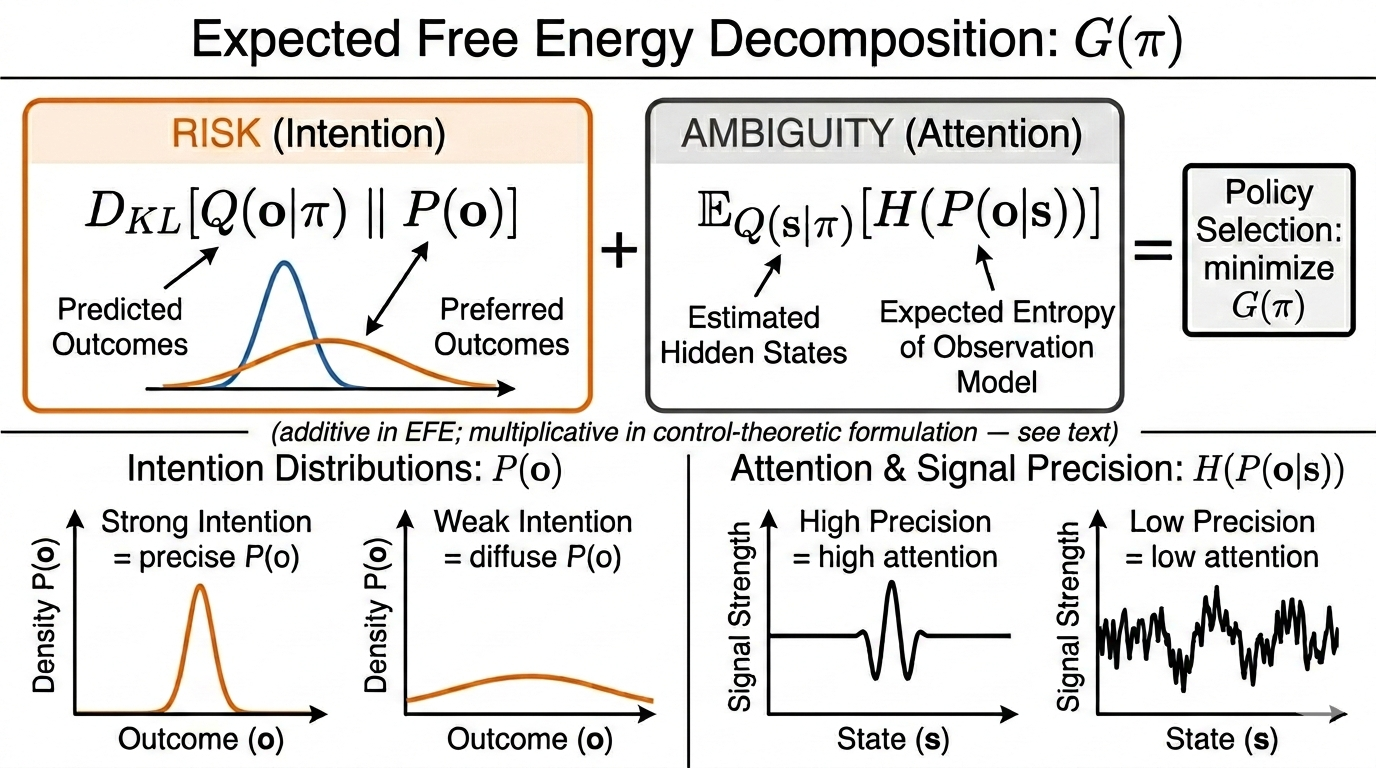
The A2 System formally maps attention and intention onto the two mathematically separable components of Expected Free Energy (EFE) within Karl Friston's Active Inference framework. The Risk and Ambiguity terms are themselves established active inference math (Friston; Da Costa et al., 2020), not a metaphor. What the A2 System proposes is a reading of those two terms: Intention maps to the Risk term, Attention maps to the Ambiguity term. This mapping is a proposed interpretation, offered as a testable claim, not a result stated in the active inference literature, where attention is more often mapped to precision.
The Unified Equation
The Expected Free Energy equation decomposes into two distinct forces:
G(pi) = Risk (Intention) + Ambiguity (Attention)
-
Intention (Risk): The KL divergence between predicted outcomes and preferred outcomes. This is the "goal vector." It acts like gravity in state space, pulling the agent toward preferred future states. Proposed neural substrate: prefrontal-striatal loops modulated by dopamine.
-
Attention (Ambiguity): The expected entropy of observations given hidden states. This is the "precision modulator." It gathers information to reduce uncertainty. Proposed neural substrate: the Thalamic Reticular Nucleus (TRN) and parietal cortex, modulated by norepinephrine and acetylcholine.
The relationship is multiplicative, not additive. The belief update equals Precision times prediction error. If attention is zero, sensory error is ignored entirely.
Biological Hardware
The framework is grounded in dissociable neural circuits confirmed by pharmacological evidence:
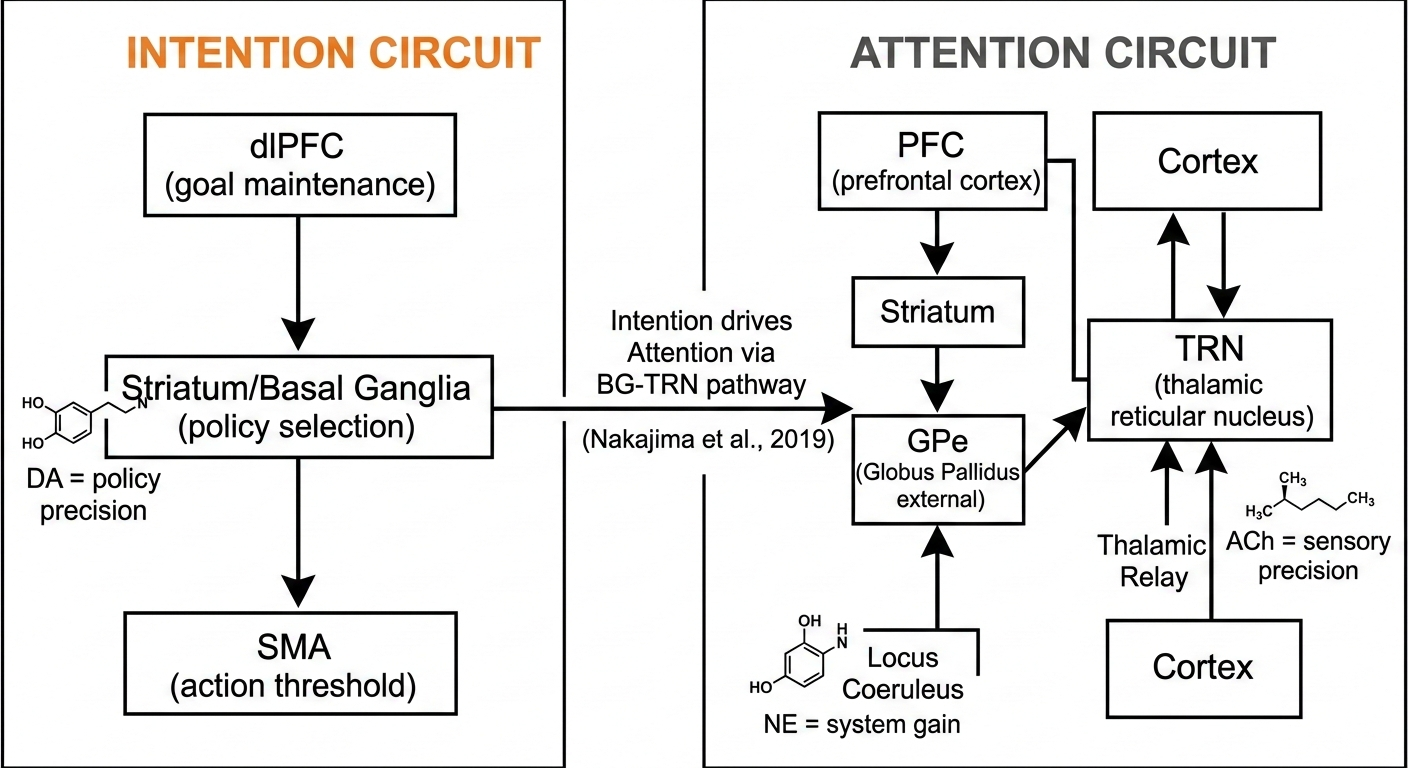
The Intention Circuit: dlPFC (the "blackboard" for goal content) projects through the striatum to the SMA. Driven by phasic dopamine. The ACC monitors the cost function. The Readiness Potential reflects stochastic accumulation of the intention vector via drift-diffusion.
The Attention Circuit: PFC projects through the striatum to the GPe to the TRN (the physical sensory gate). The TRN is a sheet of GABAergic neurons wrapping the thalamus, selectively inhibiting or disinhibiting thalamic sectors. Driven by norepinephrine (unexpected uncertainty) and acetylcholine (expected uncertainty).
The Proposed Dissociation: Dopamine manipulation tends to affect willingness to work for rewards (intention), while NE/ACh manipulation tends to affect signal detection (attention). This supports treating them as at least partly dissociable systems. The separation is not clean: dopamine also contributes to perceptual decisions, and the NE system responds to incentive, so the two are better read as distinguishable emphases than fully independent circuits.
Key evidence: Soon et al. (2008) decoded free decisions from prefrontal cortex up to 10 seconds before conscious awareness. Nakajima et al. (2019) mapped the PFC > striatum > GPe > TRN pathway. Wimmer et al. (2015) demonstrated bidirectional optogenetic control of visual TRN neurons.
The Intention Index
A proposed composite biomarker for intention strength, not yet validated. Task-evoked pupillary responses are established markers of surprise and precision-weighted prediction error, not of intention specifically, so this is a hypothesis to test rather than a settled instrument:
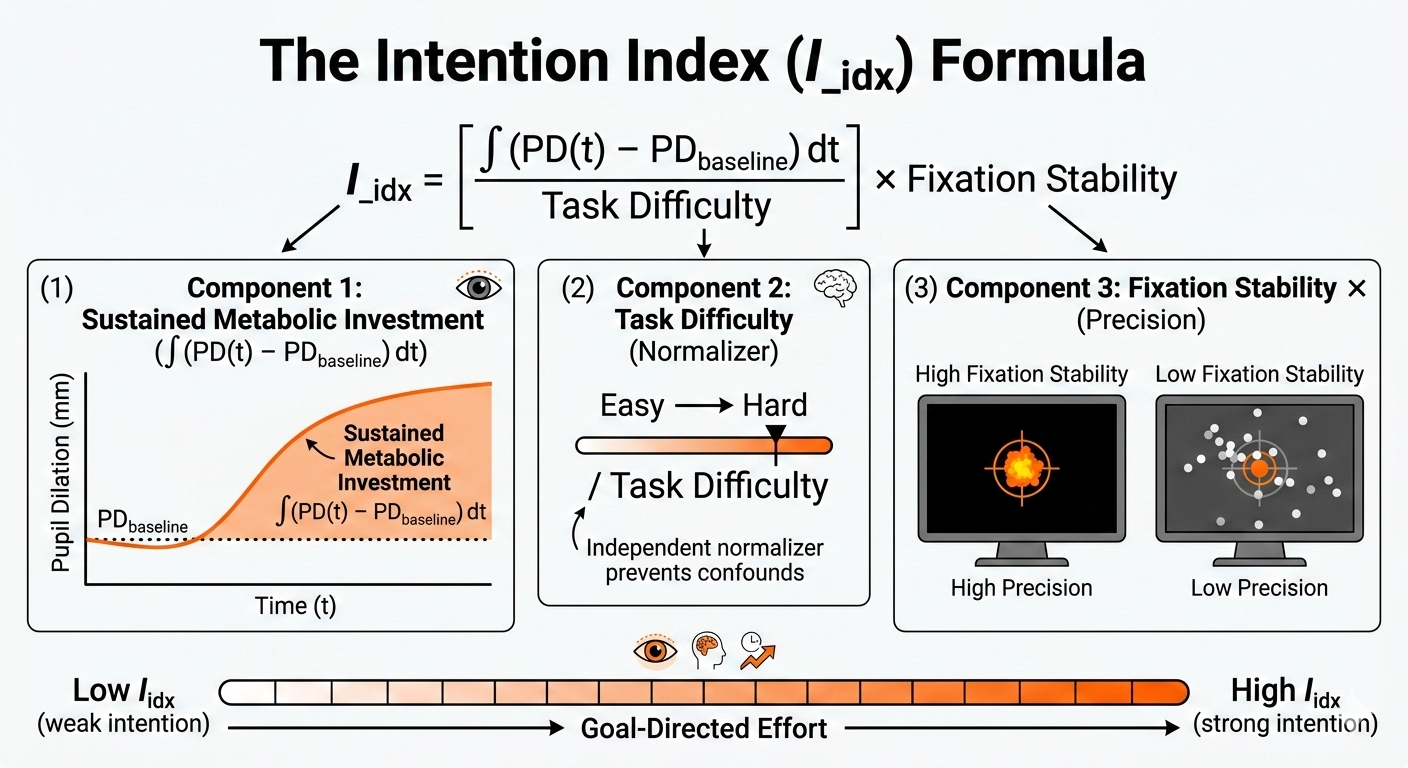
I_idx = [integral of (PD(t) - PD_baseline) dt / Task Difficulty] x Fixation Stability
Uses pupillometry (pupil dilation as a marker of Locus Coeruleus-Norepinephrine activity) combined with task difficulty normalization and eye-tracking fixation stability.
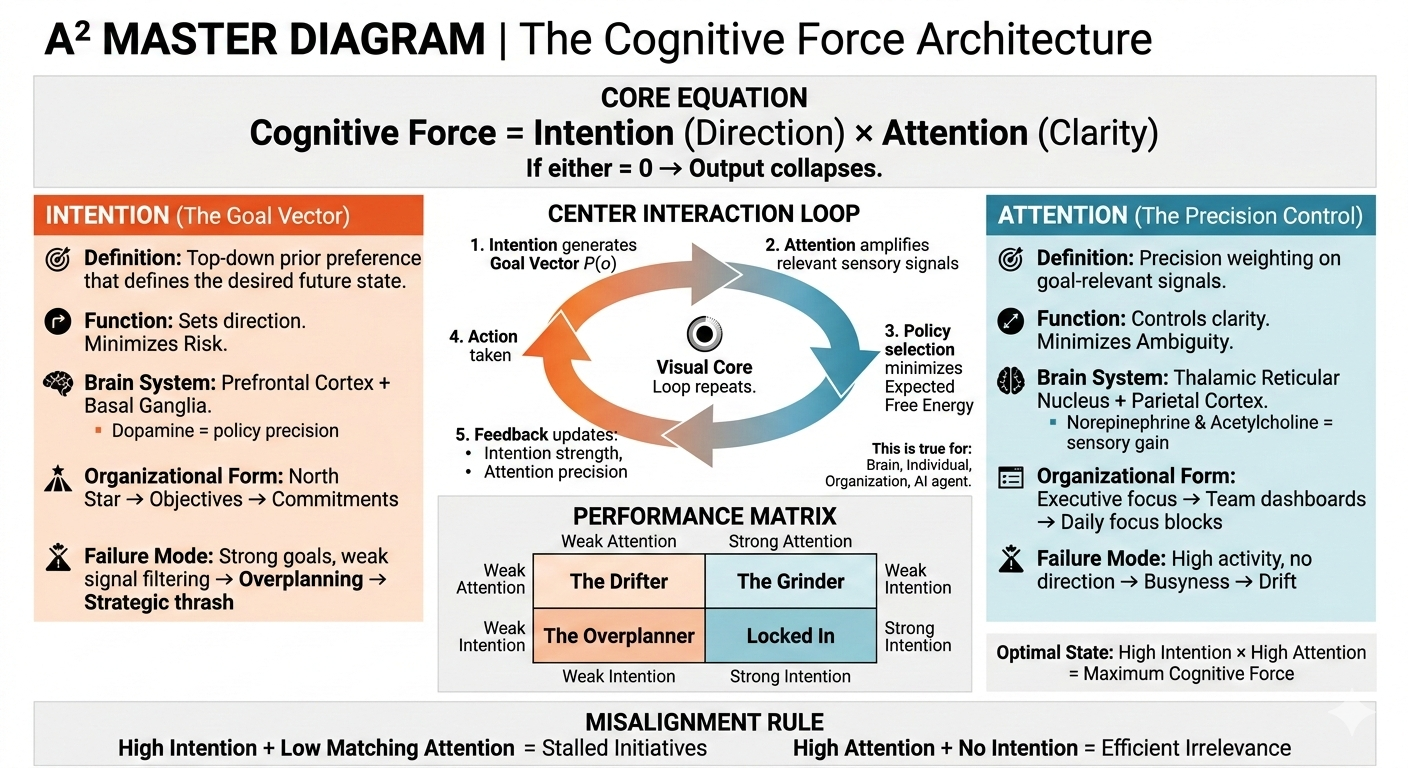
The Performance Matrix
Four quadrants from the interaction of attention and intention strength:
- The Drifter (weak both): Scattered, no direction
- The Grinder (strong attention, weak intention): Efficient execution of the wrong things
- The Overplanner (strong intention, weak attention): Clear goals, no execution clarity
- Locked In (strong both): Peak performance state
The critical insight: "High Intention + Low Matching Attention = Stalled Initiatives." "High Attention + No Intention = Efficient Irrelevance."
The Intention Engine: AI Architecture
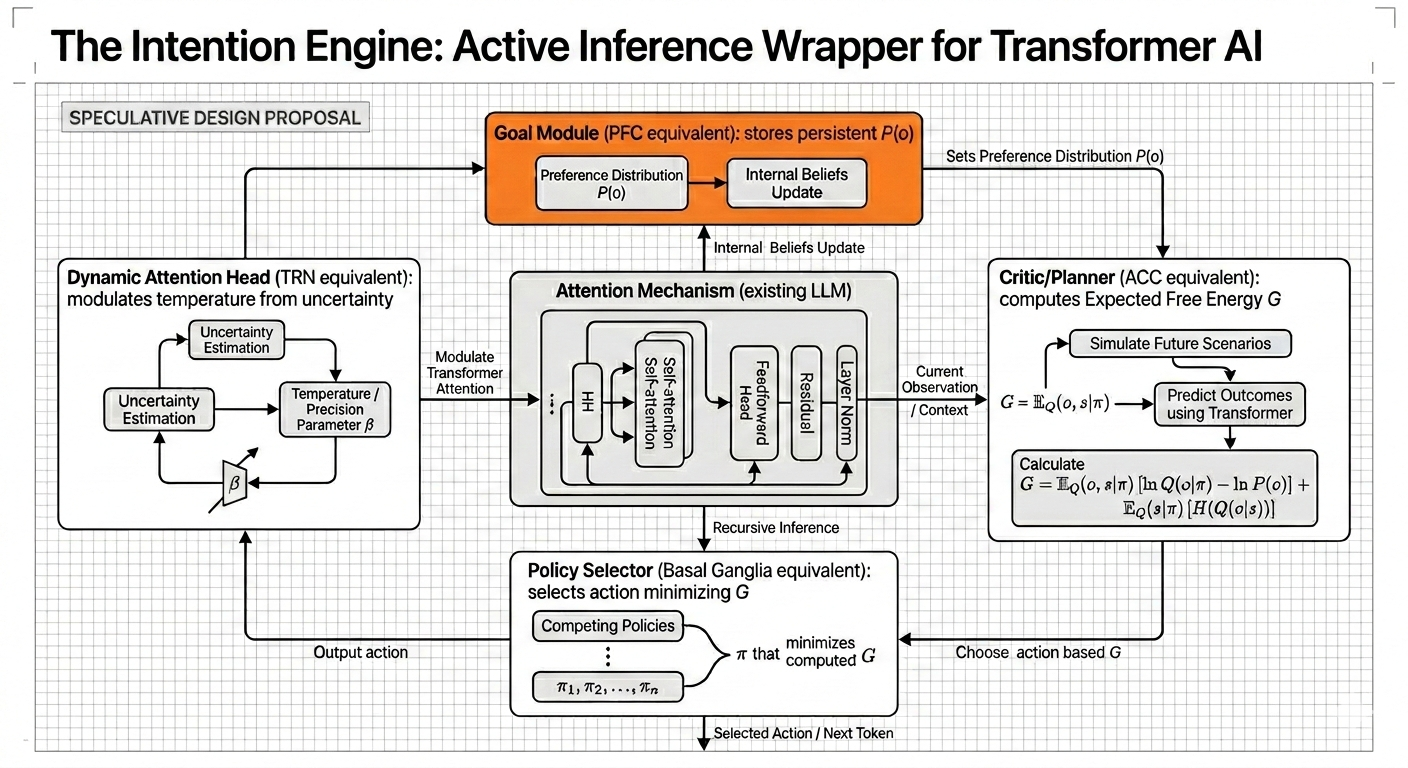
A proposed 4-module architecture for truly agentic AI, wrapping transformer models in an active inference control loop:
- Goal Module (PFC equivalent): stores persistent preferred outcome distributions
- Critic/Planner (ACC equivalent): calculates Expected Free Energy for candidate policies
- Policy Selector (Basal Ganglia equivalent): selects actions minimizing G
- Dynamic Attention Heads (TRN equivalent): modulates transformer attention temperature based on uncertainty
This is a concrete blueprint for moving beyond next-token prediction to goal-directed, uncertainty-aware AI agents.
Scaling to Organizations: The We-Intention Vector
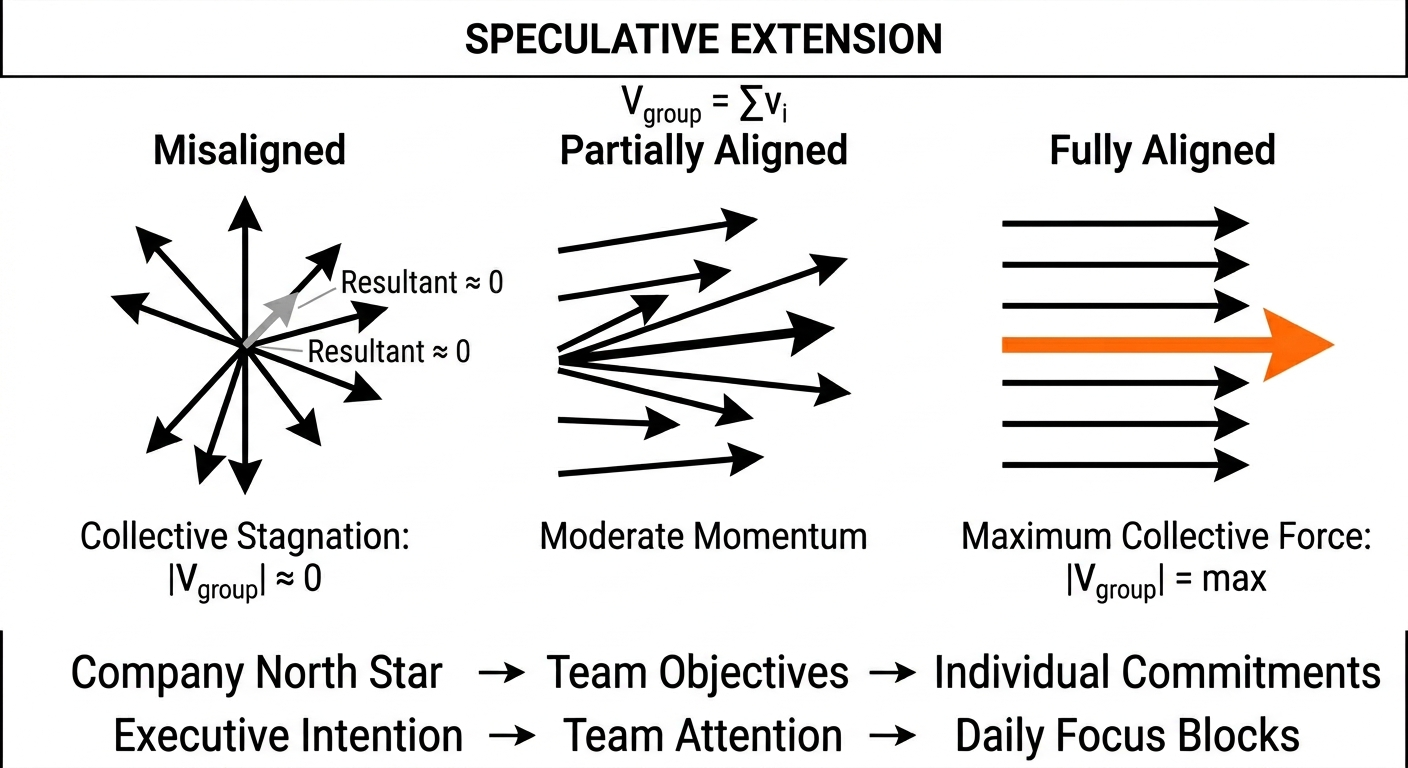
Each individual has an intention vector. Collective Intention is the vector sum. When individual vectors are misaligned (high entropy), the resultant approaches zero: collective stagnation. When aligned, magnitude is maximized: collective action. This follows Order Parameter physics, similar to magnetization in spin systems.
Applied Framework: Adult Professional Learning
A companion paper applies this framework to adult learning, identifying why some professionals adopt AI tools in one session while others struggle for months. Key findings from 800+ coaching sessions:
- The Inhibition Deficit Theory (Hasher & Zacks): Adults have a "leaky filter." They are worse at suppressing irrelevant information, not worse at remembering.
- Implementation Intentions (Gollwitzer & Sheeran, 2006): "If-Then" protocols produce a medium-to-large effect on goal attainment, d = 0.65 across 94 independent tests.
- The Illusion of Competence: Adults mistake familiarity for mastery. Re-reading feels like learning but adds almost nothing to retention.
- AI as Force Multiplier: AI amplifies whatever cognitive pattern you bring. Directed focus with clear intention produces categorically different results than scattered exploration.
Testable Predictions
- Pupil-based TEPR should dissociate between intention strength and attentional load when task difficulty is controlled
- Pharmacological manipulation of dopamine should affect Risk-related behavior without affecting Ambiguity-related behavior, and vice versa for NE/ACh
- The PFC > striatum > GPe > TRN pathway should be necessary for intention-driven attentional gating
Status
Working paper (Bullock, 2026). The formal academic version includes full citations, explicit delineation of novel versus established versus speculative claims, and rigorous mathematical notation.
Selected References
- Friston, K. (2010). The free-energy principle: a unified brain theory? Nature Reviews Neuroscience, 11(2), 127-138.
- Da Costa, L., et al. (2020). Active inference on discrete state-spaces: A synthesis. Journal of Mathematical Psychology, 99, 102447.
- Soon, C. S., et al. (2008). Unconscious determinants of free decisions in the human brain. Nature Neuroscience, 11(5), 543-545.
- Nakajima, M., et al. (2019). Prefrontal cortex regulates sensory filtering through a basal ganglia-to-thalamus pathway. Neuron, 103(3), 445-458.
- Wimmer, R. D., et al. (2015). Thalamic control of sensory selection in divided attention. Nature, 526(7575), 705-709.
- Gollwitzer, P. M. (1999). Implementation intentions: strong effects of simple plans. American Psychologist, 54(7), 493-503.
- Hasher, L., & Zacks, R. T. (1988). Working memory, comprehension, and aging: A review and a new view. Psychology of Learning and Motivation, 22, 193-225.
- Yu, A. J., & Dayan, P. (2005). Uncertainty, neuromodulation, and attention. Neuron, 46(4), 681-692.
Author: Dr. Jeff Bullock, PharmD | ORCID: 0009-0009-2053-4854
Access the Research
Download Full Paper (PDF) via Zenodo DOI: 10.5281/zenodo.19451026
- Format: White paper (self-published preprint)
- License: CC BY 4.0
- DOI: 10.5281/zenodo.19451026
Bibliography
- Friston, K. (2010). The free-energy principle: a unified brain theory? Nature Reviews Neuroscience, 11(2), 127-138.
- Da Costa, L., Parr, T., Sajid, N., Vesber, S., Ryan, V., & Friston, K. (2020). Active inference on discrete state-spaces: A synthesis. Journal of Mathematical Psychology, 99, 102447.
- Posner, M. I., & Petersen, S. E. (1990). The attention system of the human brain. Annual Review of Neuroscience, 13(1), 25-42.
- Busemeyer, J. R., & Townsend, J. T. (1993). Decision field theory: A dynamic-cognition approach to decision making in an uncertain environment. Psychological Review, 100(3), 432-459.
- Soon, C. S., Brass, M., Heinze, H. J., & Haynes, J. D. (2008). Unconscious determinants of free decisions in the human brain. Nature Neuroscience, 11(5), 543-545.
- Nakajima, M., Schmitt, L. I., & Bhatt, D. K. (2019). Prefrontal cortex regulates sensory filtering through a basal ganglia-to-thalamus pathway. Neuron, 103(3), 445-458.
- Gollwitzer, P. M. (1999). Implementation intentions: Strong effects of simple plans. American Psychologist, 54(7), 493-503.
Full bibliography available in the complete working paper.
Open Research Archive
The research behind this work is open to the public. Read the underlying deep-research reports and source material here.