

The Abundance Thesis presents a data-grounded strategic framework arguing that the cultural resilience, cognitive adaptations, entrepreneurial patterns, and community infrastructure of Black Americans represent real competitive advantages in the modern economy. It is not about inspiration. It is about evidence, systems, and leverage points.
The Problem Statement
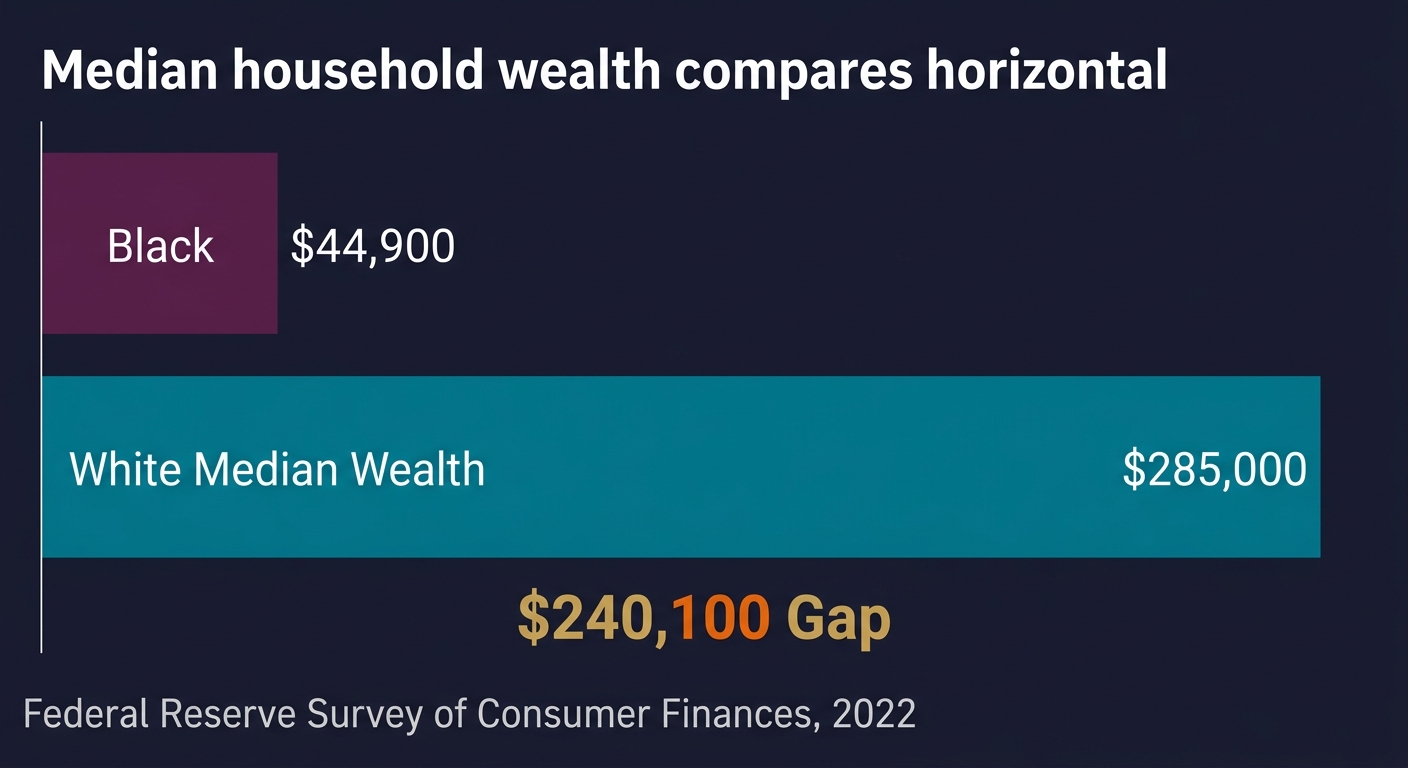
The numbers are structural, not anecdotal:
- Median Black family wealth: $44,900 vs. $285,000 for white families. Black families hold approximately $15 for every $100 held by white families. (Federal Reserve Survey of Consumer Finances, 2022)
- The absolute dollar wealth gap increased from $153,850 to $240,100. (Chicago Fed Working Paper 2024-03)
- Only 16.1% of Black-owned businesses' financing needs are met vs. 47.9% for white. Black-owned startups launch with roughly one-third the capital: $35,000 vs. $106,000. (Kauffman Foundation, 2023; Stanford, 2016)
- Closing racial gaps in wages, education, housing, and investment 20 years ago would have added $16 trillion to the U.S. economy. $13 trillion in lost business revenue from lack of credit access alone. (Citigroup, "Closing the Racial Inequality Gaps")
- 4.5 million Black jobs could be displaced by 2030 without intervention. 24% of Black workers occupy jobs with over 75% automation potential. (McKinsey Global Institute, 2019)
Yet in that same data, there are signals of extraordinary capacity:
- Black purchasing power exceeded $2 trillion in 2024. (Selig Center for Economic Growth, University of Georgia)
- Black employer businesses 2017-2022: 65.7% more revenue, 34.6% more employees, 69.5% more in payroll. (Brookings Institution, March 2025)
- Black Americans started businesses at the fastest rate of any demographic group 2020-2023, applications up 44% from pre-pandemic. (U.S. Census Bureau Business Formation Statistics)
- 83% of Black respondents are familiar with AI; more than half use AI tools daily or weekly, vs. 39% average. (Jobs for the Future, 2024-2025)
The Five Pillars
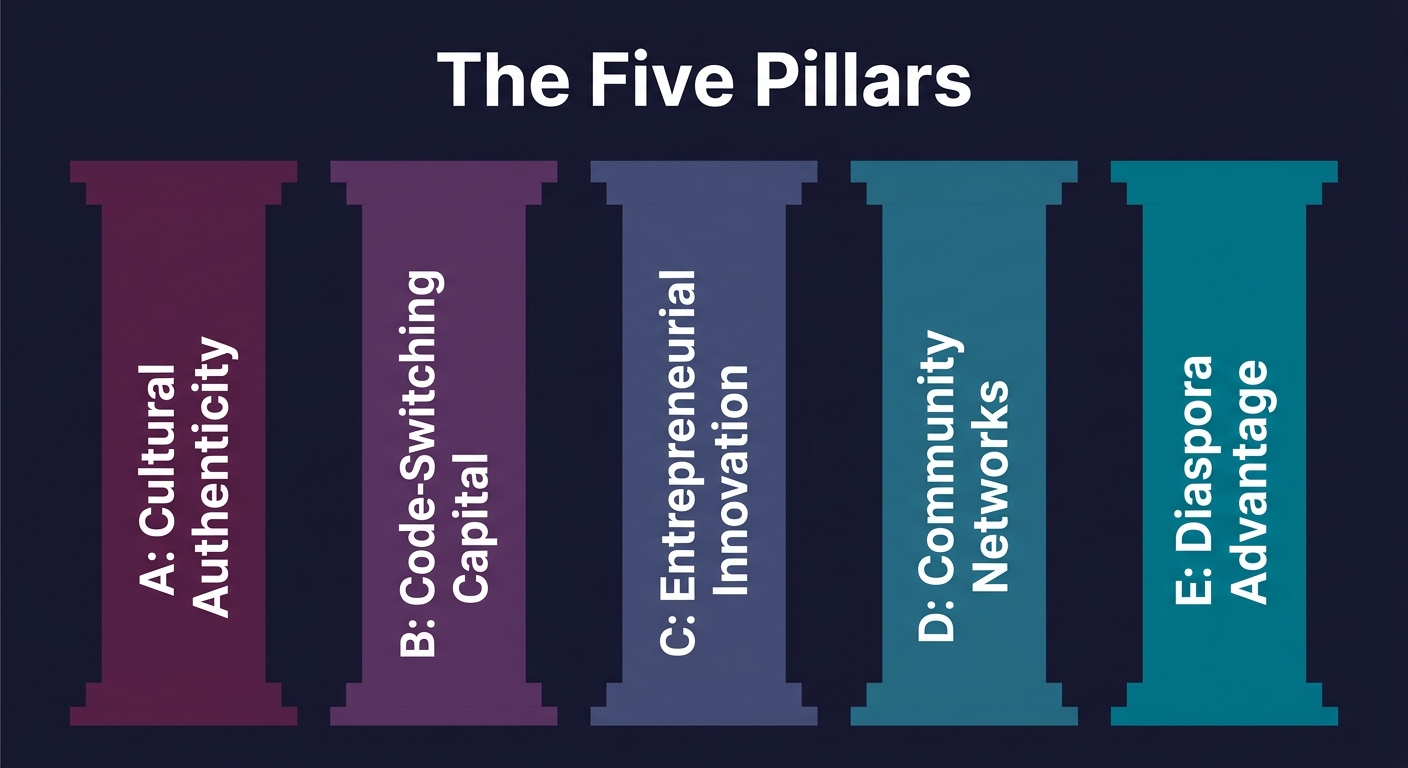
Pillar A: Cultural Authenticity and the Creator Economy. The "Authenticity Arbitrage." Authentic Black-owned brands command a premium in structurally underserved markets. AI enables "platform-native" businesses that leapfrog legacy models, the way developing nations skipped landlines for mobile.
Pillar B: Code-Switching as Executive Leadership Capital. Dense code-switching between AAVE and SAE engages proactive and reactive cognitive control mechanisms (Bilingualism: Language and Cognition, 2020). Du Bois's "double consciousness" reframed as measurable "Contextual Intelligence."
Pillar C: Entrepreneurial and Innovation Advantage. Black entrepreneurs as "platform-native" innovators. AI at near-zero marginal cost combined with affordable execution labor creates cost structures competing with funded startups.
Pillar D: Community and Network Advantage. The Black Church: 65,000+ locations, larger physical footprint than Walmart and Target combined. Over $420 billion donated cumulatively (Michigan Chronicle research). HBCUs: 3% of colleges, 20% of Black graduates, 50% of Black engineers, 70% of Black doctors (NSF/UNCF). HBCUs generate $16.5 billion in direct economic impact annually and are five times more effective than Ivy League institutions at moving students from bottom 40% to top 60% of income (UNCF).
Pillar E: Spiritual and Global Diaspora Advantage. African remittances reached $96.4 billion in 2024 (World Bank). The African tech ecosystem raised $3.2 billion with growth-stage funding surging 47% (Partech 2024). U.S.-Africa trade reached $104.9 billion in 2024 (U.S. Trade Representative). 39% of Sub-Saharan African immigrants hold bachelor's degrees or higher vs. 31% U.S.-born (Migration Policy Institute).
The Neuroscience of Advantage
Drawing on the "Hidden Talents" research (Frankenhuis & Ellis): the brain does not merely "break" under adversity. It adapts:
- Enhanced attention shifting and environmental scanning (rapid market trend identification)
- Superior working memory updating for ecological and social data (dynamic client responsiveness)
- Enhanced memory for social dominance hierarchies and superior empathic accuracy (corporate navigation)
- Superior cultural frame switching (innovation and cross-functional leadership)
The "Jazz Brain": fMRI studies reveal high-level improvisation is characterized by co-activation of the Default Mode Network and the Executive Control Network, normally anti-correlated. This "hybrid" cognitive state is the neurological signature of creative leadership (Annals of the New York Academy of Sciences, 2025).
The Abundance Flywheel
A dynamic, self-reinforcing, five-part system:
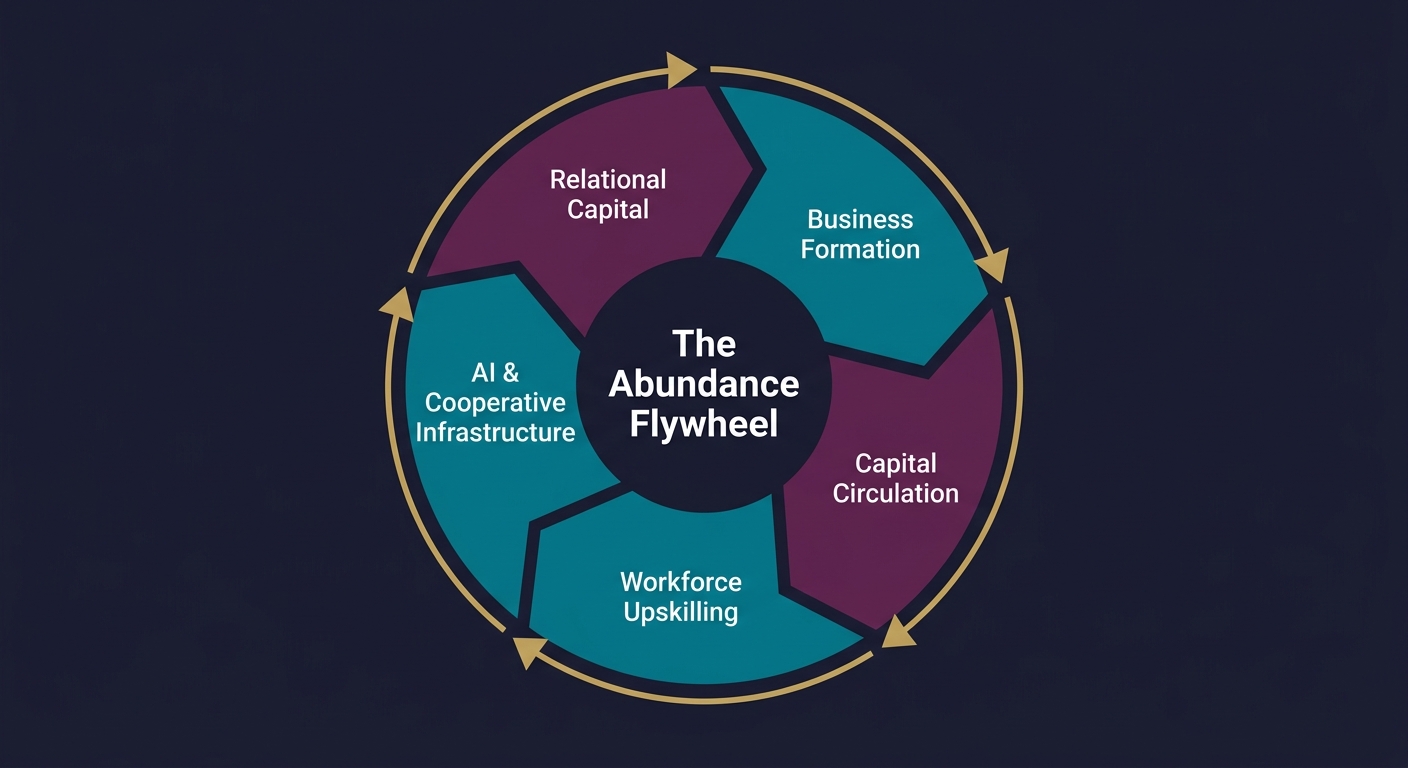
- Architect Relational Capital. Structured mentorship, peer networks, community trust infrastructure.
- Catalyze Business Formation. Industry-specific incubators and accelerators.
- Inject and Circulate Capital. Community financial stack: Special Purpose Credit Programs, CDFIs, community investment funds designed for circulation.
- Upskill the Workforce. Free, cohort-based, 16-week certification programs.
- Scale with AI and Cooperative Infrastructure. Community-owned AI platforms, virtual services co-ops.
Governance modeled on Mondragon Corporation (Basque region, Spain): 260+ worker-owned cooperatives, "one worker, one vote," highest-paid executive earns no more than 9x the lowest-paid worker-owner.
The Silver Tsunami Opportunity
Baby Boomers own 2.3-2.9 million small businesses employing 32+ million people. $10-14 trillion in assets will change hands. 73% plan to transition in the next decade. 80% have no succession plan. 70-80% of listed businesses do not sell. Over 50% prioritize legacy over sale price. Search fund aggregate IRR: 35.1% and ROI of 4.5-5.2x (2024 Stanford Search Fund Study).
Key Sources
Federal Reserve Survey of Consumer Finances (2022), Chicago Fed Working Paper 2024-03, Citigroup "Closing the Racial Inequality Gaps," McKinsey Global Institute "The Future of Work in Black America" (2019), Selig Center for Economic Growth, Brookings Institution "Driving Prosperity" (2025), U.S. Census Bureau Annual Business Survey, Kauffman Foundation (2023), Jobs for the Future (2024-2025), UNCF Frederick D. Patterson Research Institute, National Science Foundation, World Bank Migration and Development Brief 40, Partech 2024 Africa Tech VC Report, Exit Planning Institute, 2024 Stanford Search Fund Study. Full bibliography: 280+ sources across the research brief.
Status
Research brief completed (50 pages, 280+ source citations). The Abundance Flywheel master plan includes a 24-month Allentown, PA pilot blueprint and national scaling vision. Full publication forthcoming.
Selected References
- Federal Reserve Board. (2022). Survey of Consumer Finances. Washington, DC.
- Chicago Fed Working Paper 2024-03. Racial Wealth Gains and Gaps.
- Citigroup. (2020). Closing the Racial Inequality Gaps: The Economic Cost of Black Inequality in the U.S.
- McKinsey Global Institute. (2019). The Future of Work in Black America.
- Brookings Institution. (2025). Driving Prosperity: Black Employer Businesses 2017-2022.
- Kauffman Foundation. (2023). Access to Capital for Entrepreneurs: Removing Barriers.
- Fairlie, R. (2020). The Impact of COVID-19 on Small Business Owners. NBER Working Paper 27309.
- Frankenhuis, W. E., & Ellis, B. J. (2023). Hidden talents in harsh environments. Development and Psychopathology, 35(4).
- UNCF Frederick D. Patterson Research Institute. (2024). HBCUs Making America Strong.
- Jobs for the Future. (2025). AI and Black Workers: Preparedness and Opportunity.
Author: Dr. Jeff Bullock, PharmD | ORCID: 0009-0009-2053-4854
Access the Research
Download Full Paper (PDF) via Zenodo DOI: 10.5281/zenodo.19451597
- Format: White paper (self-published preprint)
- License: CC BY 4.0
- DOI: 10.5281/zenodo.19451597
Bibliography
- Federal Reserve Board. (2022). Survey of Consumer Finances. Board of Governors of the Federal Reserve System.
- Citigroup. (2020). Closing the Racial Inequality Gaps: The Economic Cost of Black Inequality in the U.S.
- McKinsey Global Institute. (2019). The Future of Work in Black America.
- Frankenhuis, W. E., & Ellis, B. J. (2023). Hidden talents in harsh environments. Development and Psychopathology, 35(4), 1627-1638.
- Brookings Institution. (2025). Driving Prosperity: Black Employer Business Growth 2017-2022.
- Kauffman Foundation. (2023). Access to Capital for Entrepreneurs: Removing Barriers.
- Stanford Graduate School of Business. (2024). 2024 Search Fund Study: Selected Observations.
Full bibliography (280+ sources) available in the complete research brief.
Open Research Archive
The research behind this work is open to the public. Read the underlying deep-research reports and source material here, the same archive that backs The Black Advantage.