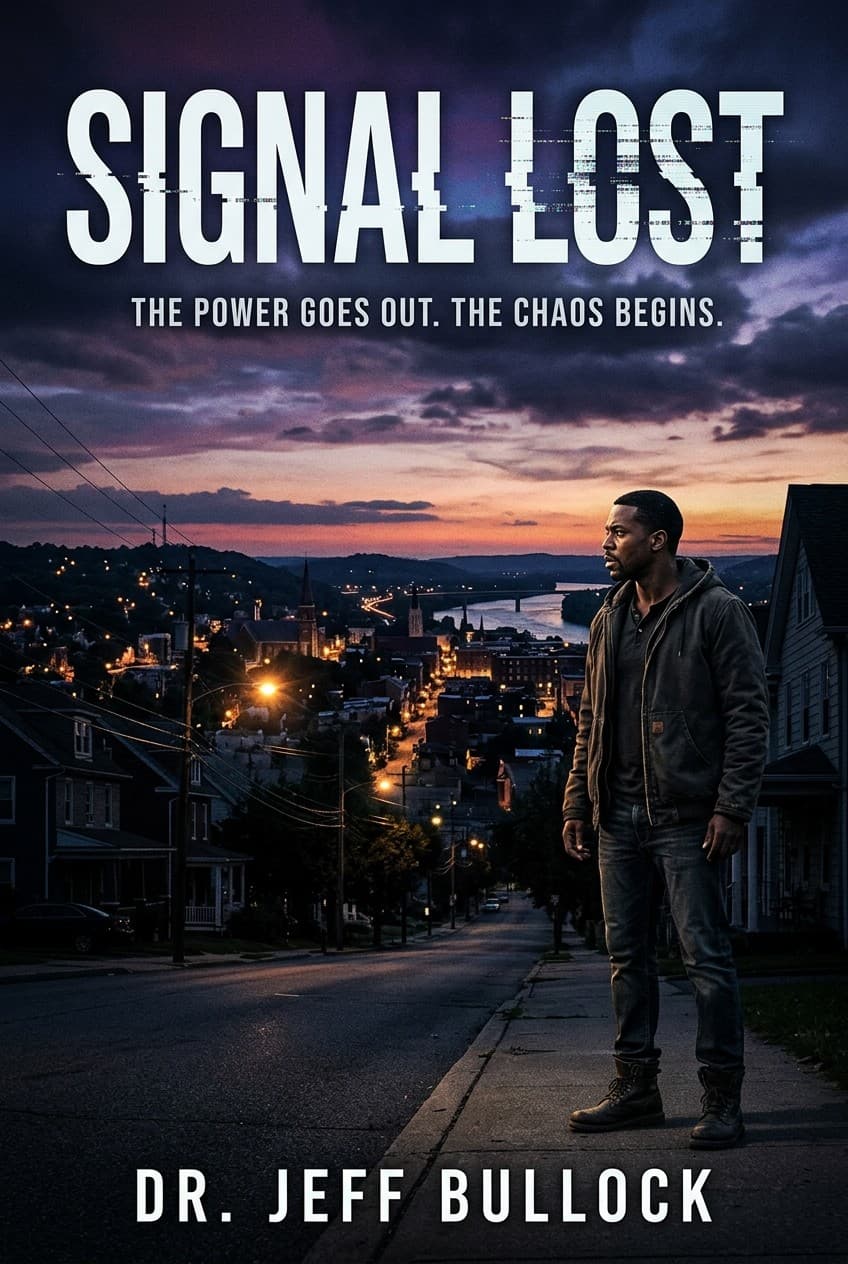
DeShawn Briggs, a medical billing specialist at St. Luke's Hospital in Easton, Pennsylvania, is handed a ninety-day displacement notice: the AI platform Aegis-Med is taking over his job. Days later, the power goes out across the Eastern Interconnection and does not come back. His neighbor Roshan Tehrani, a retired telecom engineer and Iranian immigrant who spent years quietly prepping, becomes his guide to what a real grid collapse looks like: dead cell towers, dry taps within seventy-two hours, a National Guard checkpoint that won't open a bridge because its safety systems can't get a network handshake, a grocery store dissolving into price-gouging and near-riot. DeShawn wades the Lehigh River with Roshan to rescue his ex-wife Keisha from her sixth-floor apartment; his ten-year-old daughter Imani becomes an unlikely logistics partner, running survival math on an offline AI tutor called Sage.
DeShawn helps a colleague, Sandra Chen, build a resume for a job market that no longer exists, then fails to stop her from going alone to find her daughter, resulting in a broken wrist he splints with magazines and tape. He organizes North 14th Street into a pooled household, defuses a scapegoating mob turning on Roshan over his Iranian background, and joins a fuel run that raids an unattended landscaping company's tanks, leaving a note and an IOU. Interspersed are chapters from Tariq, a young engineer in a bunker outside Tehran who built the attack: legal, open-source-sourced cyberweapon targeting SCADA systems, logging casualty counts in a Moleskine while calling his mother about dinner. His after-action report notes one anomaly: DeShawn's block, Sector 4-B, held together with zero violent deaths while neighboring sectors collapsed, attributed to a few residents with technical and organizational skill.
Power flickers back after roughly two weeks. St. Luke's calls DeShawn back, not to his old job but to ride herd on the same AI, now hallucinating fraud flags because it can't reconcile a world it didn't predict. The book ends about six weeks after the blackout: DeShawn is running a neighborhood preparedness workshop out of Roshan's garage, using a tool he built from Aegis-Med's own logic, teaching fourteen neighbors, including Gary, who once turned on Roshan out of fear, to see the fragile supply chains under their daily lives. Roshan's sister Shahrzad, beaten but unbroken by the regime back in Tehran, is still protesting. The novel closes with DeShawn at his kitchen table with Keisha, balancing the week's ledger of gallons and cans, no longer waiting for instructions to get clearer.
Themes
- Automation and obsolescence: what happens to a person's identity and worth when an AI is objectively better at their job
- Fragility hidden inside efficiency: the same optimization logic that displaces workers is the exploit that collapses the power grid
- Preparedness as care, not paranoia: Roshan's prepping is reframed from doomsday hobbyism to love for his neighbors
- The gap between knowing what to do and doing it in time (DeShawn's overplanning costs Sandra a broken wrist)
- Community as the actual redundancy system when institutions fail
- Immigrant memory as foresight: Roshan's experience of the 1979 revolution and Iranian internet shutdowns lets him read the coming collapse that Americans can't see
- Fear looking for someone to blame (the mob turning on Roshan) versus fear given a task
- The same tool (AI, data, logic) can be a weapon or a lifeline depending on who wields it and why
- Fatherhood and competence: DeShawn relearning how to be present and decisive rather than just correct
Characters
- DeShawn Briggs: medical billing specialist at St. Luke's, eleven years in, given a 90-day displacement notice by the AI platform Aegis-Med; a 'system seeker' who becomes the de facto organizer of his block during the blackout, then a community preparedness teacher after
- Imani Briggs: DeShawn's ten-year-old daughter, a digital native who treats an offline AI tutor named Sage as a normal part of thinking, and who builds the household's survival inventory and maps with clinical calm
- Keisha: DeShawn's ex-wife, a graphic designer displaced by AI-generated logos who had already been quietly prepping (filled bathtubs, packed bag); rescued from her sixth-floor apartment across the river and reunites the household under one roof
- Roshan Tehrani: retired telecom engineer, Iranian immigrant who left Iran in 1991 and lived through the 1979 revolution and the Iran-Iraq war; saw the collapse coming, teaches DeShawn survival math, radio, and fuel logistics, and absorbs a neighbor's fear-driven accusation with grace
- Sandra Chen: retired school librarian turned medical records clerk, also displaced; DeShawn writes her a resume, then fails to accompany her on a supply run in time, and she returns with a broken wrist
- Gary: a neighbor who initially tries to scapegoat Roshan over the Iran connection in the radio broadcast, later apologizes and becomes one of the fourteen regulars at DeShawn's preparedness workshop
- Lieutenant Donna Frazier: National Guard officer running the checkpoint and fuel distribution, bound by orders and protocol even when they cost lives, who quietly tips DeShawn off to unlisted private fuel tanks
- Tariq: a young engineer working in a bunker outside Tehran who builds and deploys the AI-driven SCADA attack that takes down the Eastern grid, logging casualty counts in a notebook while making excuses to his mother about dinner; his after-action report flags DeShawn's block as an anomaly worth studying
- Shahrzad: Roshan's sister, a teacher in Tehran, beaten by the regime for protesting, whose ongoing resistance parallels the rebuilding on North 14th Street
Comparable To
- Station Eleven (Emily St. John Mandel), community rebuilding after systemic collapse
- One Second After (William R. Forstchen), grid-down survival thriller with a suburban/small-town focus
- The Every / The Circle (Dave Eggers), technology critique through a very grounded, character-level lens
- Severance (Ling Ma), white-collar obsolescence and quiet apocalypse tone
- Leave the World Behind (Rumaan Alam), slow-dawning systems collapse witnessed by ordinary families
Who It's For
Readers who want a grid-down thriller that isn't about gun stockpiles and lone wolves, it's about a laid-off billing clerk, his ex-wife, his ten-year-old, and a prepper neighbor learning that the systems holding modern life together are thinner than anyone admits, and that the fix is knowing your neighbors' names before you need them. The strongest hook is the double-edged AI: the same technology that renders the hero obsolete at work is also the thing that quietly wrecks the country, and by the end he's using its own logic to rebuild his block.