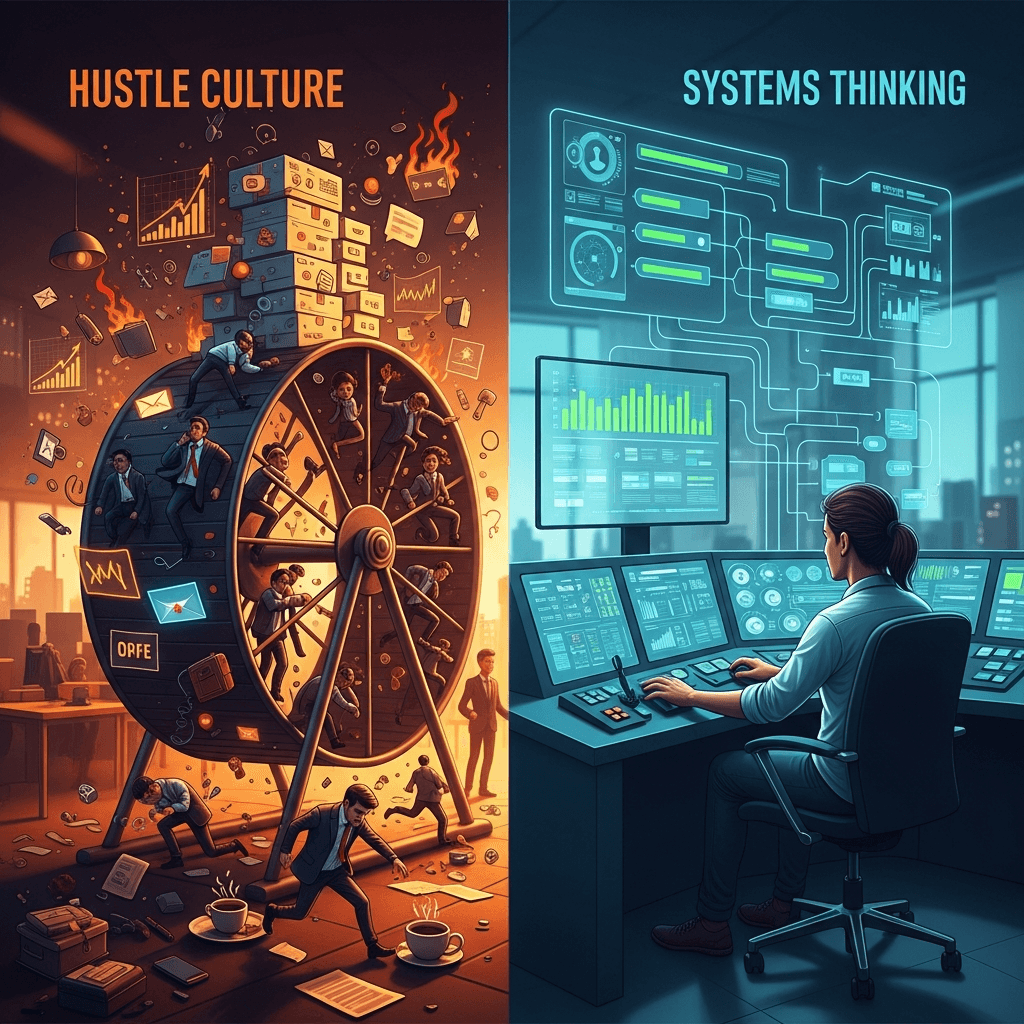
There are two kinds of people building things right now: hustlers and operators.
Hustlers post about the grind. Operators build the system that makes the grind unnecessary.
This is not a motivational distinction. It's a structural one. And it matters more in the AI era than it ever has before. I see the difference every week in coaching sessions, and the gap between the two is accelerating.
Hustlers vs. Operators
A hustler works 16-hour days and wears it like a badge. An operator works 16-hour days once, to build something that runs without them. A hustler's revenue is directly tied to their time. An operator's revenue is tied to their systems.
The hustle mindset says: do more, faster, longer. The operator mindset says: build once, run continuously, improve iteratively. One is linear. The other compounds.
I coach business owners across industries. Financial services, insurance, healthcare, marketing, legal, real estate. The ones who break through are never the ones who simply work harder. They're the ones who stop doing the work and start building the machine that does the work.
What Operators Look Like in Practice
One of my clients runs a financial services firm. Before we started working together, his team spent the better part of a day manually comparing financial statements across periods. It was meticulous, necessary work. The kind of work that feels productive because it's hard.
In one of our sessions, we built an AI project that now performs that same comparison in minutes. Not approximately. Not a rough summary. A detailed, accurate comparison that his team can review and act on instead of compile. That's operator energy. He didn't get faster at the old process. He eliminated the old process entirely.
Another client in the insurance industry told me during a session that learning to use AI tools had fundamentally changed how he thinks about competitive advantage. His exact framing was that the knowledge made him dangerous. Not dangerous in the reckless sense. Dangerous in the sense that he now sees opportunities his competitors cannot see, because they're still doing everything manually. He builds his own training materials, recruitment dashboards, and content systems. At 71 years old, he's the most innovative person in his organization because he thinks like an operator.
A coaching client in education described how AI had transformed her entire job. Not just one task. The whole workflow. She stopped needing an assistant for the things that used to consume her day, because the AI handled the repetitive cognitive load. The time she recovered went straight into the work that actually required her judgment and creativity.
These aren't edge cases. This is what happens when someone with domain expertise adopts operator thinking.
Why This Matters Now
AI changes the math. Before AI, building systems required teams, capital, and time. Now a single operator with the right AI stack can build automation that used to require a department. Email triage that runs three times a day without human input. Market intelligence that scans RSS feeds and delivers briefs. Session recaps that capture every meeting and extract action items automatically.
These aren't hypotheticals. These are systems I run every day across my companies. I manage a 49-module AI platform across seven layers: ingestion, triage, analysis, communications, pipeline, integrations, and monitoring. It handles email, market intelligence, session recaps, strategic briefings, client tracking, and content generation. The platform processes hundreds of transcripts and manages a pipeline of over 145 prospects.
None of that was built in one weekend sprint. It was built incrementally. One module at a time. One loop at a time. One problem solved, then the next. That's the operator way. You don't try to build the whole machine on day one. You build the first loop, make sure it works, then build the next one on top of it.
Thinking in Loops
An operator looks at any repeated task and asks: can this be a loop? Not "can I do this faster" but "can I build something that does this without me?"
The difference is fundamental. One question optimizes your time. The other eliminates the need for your time entirely.
Every email you manually triage is a loop you haven't built. Every report you manually compile is a system you haven't designed. Every decision you make from scratch, when the inputs are predictable, is a failure of architecture.
Here's a concrete example. I run coaching sessions with business owners every week. After each session, someone needs to write a recap: what was discussed, what the action items are, what's due next. A hustler writes that recap manually after every call. An operator builds a system that ingests the transcript, extracts the key points, identifies the commitments, and drafts the recap automatically. The human reviews it, approves it, and sends it. The cognitive work of synthesis still happens. But the mechanical work of formatting, organizing, and drafting is gone.
That pattern applies to everything. Financial reporting. Client onboarding. Content creation. Market research. Competitive analysis. The question is never "how do I do this faster?" The question is "how do I build something that does this without me?"
The Operator Stack
Operator energy is not about working less. It's about building leverage into everything you touch. The stack looks like this:
- Identify the loop. What repeats? What are you doing this week that you also did last week?
- Design the system. What are the inputs, the logic, and the outputs? Can you describe the process clearly enough that someone else could follow it?
- Build it once. Use AI, automation, whatever gets it running. The tool matters less than the thinking.
- Monitor and improve. Systems need maintenance, not babysitting. Check the outputs. Refine the logic. Let it compound.
This is how one person runs two companies with autonomous AI agents handling email, market intelligence, session recaps, and strategic briefings. Not by hustling. By operating.
The Compounding Effect
The thing about operator thinking that hustlers miss is the compounding. When you build a system that saves you two hours a week, you don't just get those two hours back. You get those two hours every week, forever. And you use some of that recovered time to build the next system.
After 475 coaching sessions, I've watched this pattern play out across industries. The clients who build one system and then build another on top of it start to pull away from their competitors within months. The ones who keep hustling harder stay flat. Their effort increases linearly. The operator's output increases exponentially.
The best example is the client who built an AI project for financial statement comparison. That wasn't the end. Once he saw what was possible, he started building projects for client analysis, market research, and competitive intelligence. Each system freed up time that he invested in the next system. Within a few months, his firm was operating with capabilities that would have required an entire analytics department.
How the 49-Module System Got Built
People sometimes ask how I built a 49-module AI platform as a solo founder. The answer is boring: one module at a time.
The first module was email triage. I was drowning in email across multiple accounts. So I built a system that classifies incoming messages, identifies the actionable ones, and drafts responses. That took a week. Once it was running, I had two hours back every day.
I used those two hours to build the next module: transcript ingestion. I was conducting coaching sessions and losing track of what was discussed. So I built a system that pulls transcripts from Google Drive, indexes them, and makes them searchable. Now I can pull every session with any client in seconds.
Then came the analysis layer. Four AI personas, each examining transcripts from a different business perspective. Then the pipeline module for tracking prospects. Then the market intelligence scanner. Then the session recap generator. Then the monitoring layer that watches everything else.
Each module was built with time freed up by the previous module. That's what compounding looks like in practice. It's not dramatic. It's incremental. And after enough increments, you look up and realize you have something that would take a team of ten to replicate manually.
The Hard Part
The hard part of operator thinking isn't technical. It's psychological. Hustlers get dopamine from doing the work. There's a satisfaction in the grind, a feeling of productivity in the effort itself. Operators have to give that up. You have to be willing to spend a day building something that produces no visible output, knowing that it will produce output every day after that.
That's the trade. Visible effort today for invisible leverage tomorrow. Most people choose the visible effort. Operators choose the leverage.
The other hard part is behavior change. I see this in every coaching session. The client understands the concept. They agree with the logic. But when they sit down at their desk, they default to the old way. They open the email and start typing instead of letting the system draft it. They compile the report manually instead of running the automation. The biggest piece is breaking the behavioral habit. It's a different way of working, and it will speed you up, but you have to remember to do it. You have to remember to talk to the AI.
The Bottom Line
Hustle culture sells because it's simple. Work harder. Sleep less. Post about it. But it doesn't scale, and it doesn't last. Systems scale. Loops compound. Leverage multiplies.
The AI era rewards operators disproportionately. The gap between "I do everything myself, faster" and "I built something that does it for me" has never been wider. And it's getting wider every month.
Be an operator.