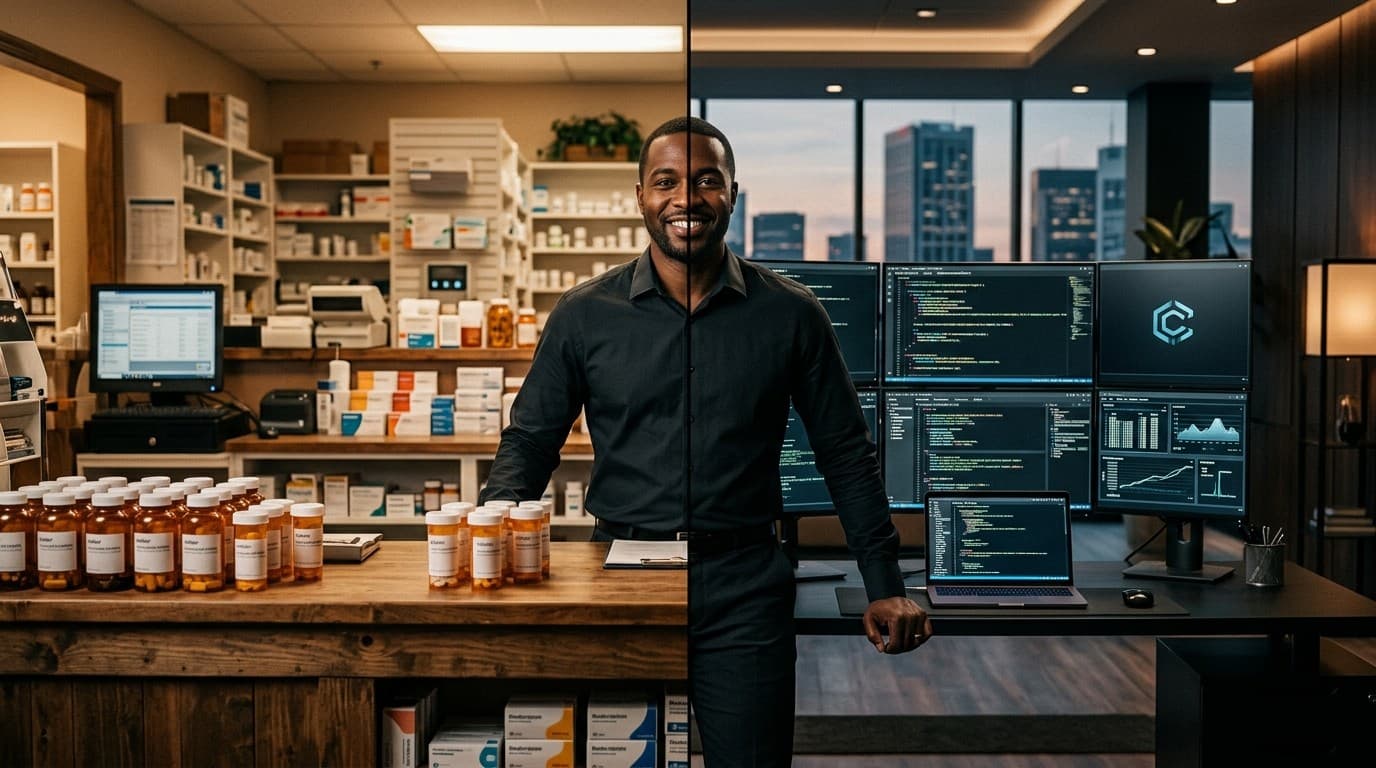
People hear that I am a pharmacist who now runs an AI consulting firm and they assume there is some clean, linear narrative. There is not. The real story involves 18 years in retail pharmacy, two failed businesses, a pandemic, and a realization that nobody was coming to save me.
Let me tell it properly.
The CVS Health Years (2003 to 2021)
I started at CVS Health as a pharmacy clerk. I was still in pharmacy school at Xavier University of Louisiana, earning my PharmD. Over the next 18 years, I worked my way up from clerk to pharmacist to district leader.
If you do not know what a district leader does in retail pharmacy, here is the short version: you manage multiple pharmacy locations, handle staffing, hit revenue targets, manage compliance, and solve every operational problem that floats up from the stores. You are part operator, part firefighter, part coach.
Those 18 years taught me things that no AI course or business book could. I learned how to manage people, because pharmacy teams are small, high-stress, and unforgiving of poor leadership. I learned how to read financial statements, because district performance was measured in numbers. I learned how to build systems, because running multiple locations simultaneously requires systems, not heroics.
I also learned what burnout looks like from the inside. Retail pharmacy during the years I was there went through massive consolidation, staffing cuts, and increasing demands on pharmacists. When the pandemic hit, the pressure became something else entirely.
I was a pharmacist at 23 making six figures. I did everything "right." I was traveling internationally with friends because we could afford it. But when I looked around, I realized something that bothered me deeply. The system worked for me, but it did not work for everyone. And even for me, it worked only as long as I kept trading time for money inside someone else's organization.
The First Businesses (2021 to 2023)
I left CVS in 2021 and started CJ Freight & Logistics, then CJ Dispatch. Both failed.
I am not going to sugarcoat this part. Those businesses taught me expensive lessons about labor, margins, and the gap between a good idea and a viable operation.
"In my first business, labor was too expensive. I was paying for lessons because I was not efficient yet. I tried using virtual assistants, but they were inconsistent. If I did not have work for them one week, I would lose them and have to retrain someone new."
That pattern, hiring people, training them, losing them, repeating, was the core problem. It is the same problem millions of small business owners face. When you are small, you cannot afford a full-time team. But without a team, you cannot scale. So you stay stuck.
I realized that 95% of entrepreneurs in my community are solopreneurs. "If you are a business owner and you are by yourself, you are not scaling. You cannot do it all. You need systems."
That realization is what led me to AI. Not as a curiosity. Not as a trend to ride. As a solution to the labor problem that killed my first two businesses.
The AI Inflection Point
In June 2023, I founded PRISM AI Consultants. The name stands for Positivity, Resilience, Innovation, Service, and Mastery. Those are not marketing words. Those are the values I operate by daily.
The thesis was simple: AI could give small business owners the operational capacity they need without the labor cost that kills them. Transcription tools could capture meetings automatically. Large language models could analyze data, draft documents, and produce deliverables. Custom GPTs could encode business expertise into reusable tools.
But I did not want to be another AI influencer making YouTube videos about prompting tips. I wanted to build something that produced measurable results for real businesses. So I structured PRISM as an implementation firm. We do not just teach people about AI. We build AI workflows into their operations and measure the impact.
From the beginning, I tracked everything. Every coaching session recorded and transcribed. Every client interaction documented. Every outcome measured. Through empirical data, trial and error with group presentations where I trained over 100 people, I determined the best way to actually get people to retain the information: you need to tie it directly to their specific business goals, and they need to be actively using the tools between sessions.
Building the Agent System
What happened next is the part of the story that surprises people most. I did not just coach clients on using AI tools. I built an entire AI agent system to run my own businesses.
As of today, PRISM runs on a multi-agent platform with over 30 specialized AI agents. There is a Sovereign Agent that acts as the revenue pressure engine, calculating targets, pipeline coverage, and pacing. There is a BizDev Agent that manages outreach. There is a Speaking Agent that researches and tracks conference opportunities. There is a Game Studio Agent that manages marketing for the games I build. There is a Security Audit Bot, a Content Miner, a Session Indexer, and more.
Each agent has a specific job, a specific schedule, and specific data it reads and writes. They run on a combination of cron jobs on our VPS server and launchd on my Mac. The entire system is built in Python, orchestrated by automation scripts, and monitored by a watchdog that alerts me on Slack if anything breaks.
I built all of this myself. Not because I was a software engineer before this. I was a pharmacist. I built it because the alternative was hiring a team of five to ten people to do what these agents do. And I already knew from my first two businesses what happens when you try to scale with human labor before the revenue supports it.
The system ingests meeting transcripts, manages email, tracks prospects, enforces accountability, and generates executive intelligence. It is the operational backbone of both PRISM AI Consultants and VersAssist LLC, the labor-sharing partnership I co-founded in 2024.
The Pharmacy Connection
People often ask why pharmacy-to-AI. The connection is more direct than you might think.
Pharmacy is a data profession. Every prescription is a data point. Every drug interaction check is pattern matching. Every clinical decision is a risk assessment based on incomplete information. Pharmacists are trained to process large volumes of structured data, identify anomalies, and make decisions under time pressure.
That is exactly what AI does.
When I built Pharmageddon, a browser-based pharmacy simulation game, I was not making a random game. I was encoding 18 years of pharmacy experience into interactive software. The chaos in that game, the insurance denials, the angry customers, the impossible staffing, the mountain of prescriptions, that is autobiographical. It went viral on Reddit's pharmacy community because pharmacists recognized their own reality in it. Over 23,000 people viewed the post. 389 upvotes. Nearly 90 comments, most of them some version of "this is painfully accurate."
The pharmacy background also shapes how I coach. Pharmacists are trained to be precise. We do not guess at dosages. We do not approximate drug interactions. That precision carries into how I teach AI implementation. I do not give clients vague advice about "leveraging AI." I give them specific workflows with specific tools for specific tasks.
What 100-Plus-Hour Weeks Look Like
I track my productive hours in an Excel spreadsheet. I have been doing this since 2021. I consistently log over 100 productive hours per week. I wake up at 3:30 AM most days.
This is not a flex. It is context. Building a multi-agent AI system, running coaching sessions, writing books, composing music, building games, serving on community boards, and mentoring a Little Brother through Big Brothers Big Sisters requires volume. There is no hack for it. There is no "work smarter not harder" platitude that replaces the hours.
What AI does for me is not reduce the hours. It multiplies the output per hour. A task that would take me three hours manually takes twenty minutes with the right agent. That does not mean I work less. It means I accomplish more in the same time. The AI handles the mechanical work. I handle the decisions.
The Current State
PRISM AI Consultants serves business owners across dozens of industries. Our core offering is a $2,500 per month AI implementation partnership. Clients get weekly strategy sessions, custom AI workflows built for their specific business, and ongoing support as they build internal capability. We offer a money-back guarantee and do not lock anyone into long-term contracts.
I also co-founded VersAssist LLC, a labor-sharing partnership that provides virtual assistant services to businesses. The combination of PRISM (AI implementation) and VersAssist (human labor) gives clients a complete operational solution.
I host "AI Hustle with Dr. Jeff" as a weekly LinkedIn Live series on practical AI for business owners. I have published multiple books. I have composed hundreds of songs using AI music tools. I have built browser games that run on prismstudios.app. I serve on the Board of Directors for the African American Business Leadership Council and as an active Big Brother through Big Brothers Big Sisters.
None of this was the plan when I was counting pills at CVS. The plan was to be a great pharmacist. Life had different ideas. But every single thing I learned in those 18 years, every system I built, every team I managed, every fire I put out, is embedded in how I run PRISM today.
The Point
I tell this story not because it is unique but because it is not. There are thousands of professionals in healthcare, finance, education, and government who have deep operational expertise and no idea how to translate it into the AI economy. They think AI is for engineers and data scientists. It is not. AI is for operators. People who understand systems, processes, and the messy reality of making a business work day after day.
I never learned how to learn, just what to memorize. That was the core insight that changed everything. Once I understood that AI could augment the learning process itself, that I could use these tools not just to do work but to get better at doing work, the possibilities opened up.
The path from pharmacy district leader to AI CEO was not straight. It went through two failed businesses, a pandemic, and hundreds of hours of building things that did not work before they did. But the foundation, the pharmacy training, the operational discipline, the obsession with systems, that is what made everything else possible.
If you are a professional with deep domain expertise wondering whether AI is relevant to your career, the answer is yes. Your expertise is the input. AI is the multiplier. The combination produces something neither could achieve alone.